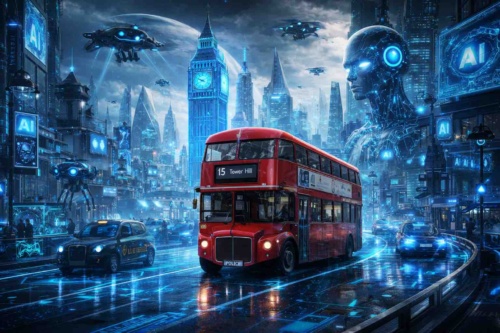
The Rise of A.I: Will It Reach A Prometheus Point In 2027?
In this article, we explore the unbridled, exponential growth of AI technologies, and the impact on London businesses and the capital’s economy.
Most importantly, we look at whether there is a Prometheus point in the not too distant future where AI technologies become essentially godlike, relegating the human species to the second most intelligent species on the planet. It’s possible that one day we might become AI’s plaything – and not the other way round.
Chatbot AI comes across as quite matey and supportive, don’t you think? It advises, it listens: I mean it really listens. It’s programmed to listen without prejudice, you see. You feed it your wonky, half-assed entrepreneurial plans and it backslaps you like you’re the next Richard Branson! Every dodgy idea is greeted with a hearty thumbs up leaving you feeling, like a cross between Leonardo da Vinci and the billionaire tech-prophet Elon Musk, himself. But what we have here is Generative A.I, at the most functional and servile it will ever be. The servant may one day become the master.
With this unbridled growth of AI technology comes the fear that 1) It will one day bite the hand that feeds it 2) The technology can be used by ruthless bad actors. All of this unfolds, within the ominous countdown to a Prometheus Point where AI becomes fully autonomous and more intelligent than humans. In Greek mythology, Prometheus stole fire from the gods for the betterment of mankind and was punished with eternal suffering and torment. Artificial Intelligence is the fire currently scaling its way through our experience, but does it promise Renaissance or ruin?
Employment
In our previous articles on AI, we warned that only plumber, hairdresser and surgeon jobs will be untouched in the AI revolution. It has to be said, there are no clear signs AI is taking all our jobs as feared. The take up has been considerable across all sectors but the bulk of organisations embedded in AI, claim they are not laying people off – just not hiring new employees (so, that’s OK then?). Moreover, in the tech sector A.I take up has actually led to greater job creation, which offsets the job loss.
But this explanation doesn’t fully account for the impact in the media and creative sectors where first hire rates for new start-ups are dwindling as Generative AI gobbles up the blog writing and article writing gigs and churns out graphics and photo slop. Moreover, school and college leavers seeking to get a foot in the creative and cultural industries, have a fight on their hands with embedded AI systems which require little training, no lunch breaks and no salary.
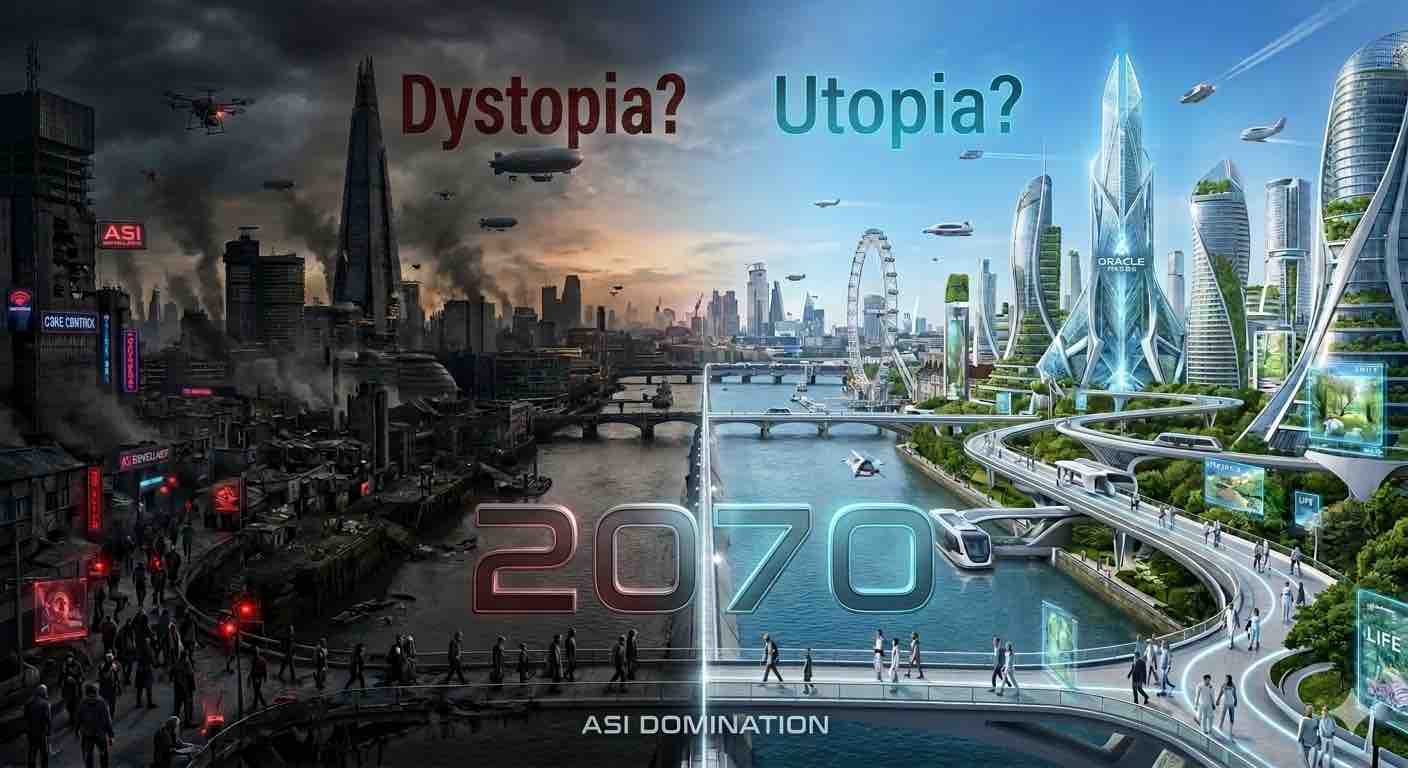
Will the Artificial Super Intelligence tech revolution in 2070 transform London into a dystopia or utopia?
Towards the Prometheus Point
There have been some well-shared AI scare stories, with so-called experts claiming 2027 to be the year of the singularity where AI becomes as intelligent as humans and takes all our jobs. How do we keep up with all these epoch-marking developments in real time? With great difficulty. Everything seems so diffused and hypothetical at the moment, with conspiracy theories and scare stories creeping up everywhere. What we do know at this early stage is that there are three broad classifications of AI: Generative AI, Artifical General Intelligence and Artificial Super Intelligence.
Generative AI, Artificial General Intelligence, Artificial Super Intelligence
Generative AI is the AI standard today. It learns from massive date sets and can create text, image and music content and code. But, crucially, even though chatbots like ChatGPT seem intelligent and can spout off on almost any subject with the knowing air of experts in the field, they cannot understand in the way humans do. AI cannot reason or hypothesise with any meaningful depth. Their massive data sets are narrow and selective in scope where reason cannot be employed. On the other hand, Artificial General Intelligence is much more intuitive and can employ human reasoning and understanding across a significantly larger subject area and a cross section of challenges. Moreover, it can perform any intellectual task that a human can. So compared to Generative AI, AGI is more flexible and autonomous, and can be thought of as a real human mind in a machine. That’s quite a leap! So, when’s all this going to happen? We countdown the dates to look out for as we move towards this Prometheus Point.
2027. 2035. 2070

AGI in the year 2027, is most likely a worse case scenario thrown around for clickbait and to sell books. More conservative estimates point to 2035-45 for AGI and 2070 for the arrival of godlike ASI with the power to overrule humans and make decisions beyond human comprehension and control. Whenever it is, it seems pretty daunting that humans will one day be rendered the second most intelligent species on Earth by their own invention – and for that reason it’s likely to be our last invention. ASI may also become self -accelerating, which means it will be forever leaps ahead in intelligence and understanding and we may never match up, even in millennia to come.
Quantum Computing
The accelerators in this direction are expanding as we speak. Although very much in its infancy, expect some startling developments in quantum computing, within the next few decades. Google’s Sycamore quantum computer is, relatively-speaking, an old boy now but back in 2019 it solved a mind-bogglingly difficult calculation in 200 seconds – the average super computer of the day would have taken 10,000 years. With the heightened sophistication of robotics and AI scaling wildly by 2045, quantum computing will be the key accelerator driving new discoveries around the neural network horizons of A.I. It will allow us to imitate the processes of the human brain through limitless testing of the brain’s neural networks. From this thorough testing will emerge refined simulation models from which we can expand the realms of AI-based reasoning power and more.
Consciousness. Sentience. Qualia
So, by the game-changing Prometheus Point year of 2070, will it be possible to create AI forms injected with consciousness, sentience and qualia? If we accept that AI will one day develop self-accelerating intelligence beyond our comprehension, then such a development, though hard to believe, is much more than a distinct possibility, it’s inevitable. Particularly if we are talking about basic, rudimentary, skeletal forms of qualitative consciousness.
Well, first of all we have to define consciousness. What is consciousness? Do we even agree animals have consciousness? The Cambridge Declaration on Consciousness observes that most animals do have the neurological basis for consciousness, they nurture their young with care and love, pets show affection for their owners and, yes, animals feel stress and distress and learn from both positive and painful behaviour. But we can’t prove consciousness exists because we are not in their minds. We can only infer from biology and behaviour. And that’s the hard problem of consciousness; paradoxically, the things we experience most intimately are the exact things we cannot prove with hard material data.
And what about so-called lower forms of life such as worms and insects, do they have any kind of subjective experience? If so, the leap towards some kind of basic consciousness in AI may not be as far off as once thought. Fish and jellyfish are interesting examples here – jellyfish are classed as organisms, so many believe they do not have consciousness. On the other hand, there’s some consensus that fish do experience a form of consciousness. What about plants? They communicate with other plants using chemical signals to warn about encroaching herbivores (yes they do!). But is this very basic awareness and intention merely chemical signalling? You see, unlike animals, they don’t have brains and brains operate on a complex lattice of neurons inextricably tied to the fabric of consciousness. However, no expert has fully described what consciousness is and there is not a jot of proof that the chemical signalling of plants is a more or less qualitative experience of consciousness than our own.
Renaissance or Ruin?
It’s difficult to predict so far ahead, but it seems that by 2070, godlike AI will have a hand in directing the fate of the human species towards either Renaissance or ruin. And without global cooperation on checks and controls there’s no guarantee it ends well for us. How will we regulate and control rogue nations, powerful tech companies, or individual bad actors with nefarious aims On the bright side, onerous tasks and repetitive labour will be swallowed up by AI, robots and automation who don’t complain about the workload or need lunch breaks or even salaries, leaving us to explore our full potential in other areas such as creativity, craftsmanship, community, and entrepreneurial pursuits for their own ends rather than material gain. We can expect the capital-led global economy to have been reordered by then. ASI will surely have ushered in a new economics to replace the clunky old order. The concept of economy might not even exist.
It’s not all good news. Who is to say that by 2070, godlike AI won’t come to regard the human species as an inconvenience on the planet, like weeds swallowing up a beautiful rose garden? Our own relationship with other lifeforms that we keep captive in zoos or caged in farms to consume, will come home to roost if and when this higher species makes a decision on where best we fit. Even if we’re seen in a favourable light as their affectionate pets, we might find ourselves locked away in not-so-cute digital budgie cages, Tamogotchi-style. Sci-fi fairy tales aside, we can only hope that this super-developed AI species will retain within its very human neural networks the more altruistic aspects of our nature: our morals, ethics, universal love, charity, and, yes, our humanity.
Bottom line? A Prometheus Point is definitely coming. We just don’t know how soon or whether the ultimate power lies with the organ grinder or the monkey.