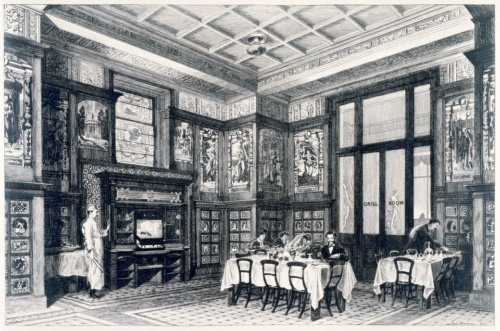
With over 2.27 million objects, the Victoria and Albert Museum, South Kensington is recognised as a world leader in the collection of applied and decorative art and design, but did you know it also has the world’s first museum restaurant?
Its three opulently decorated Victorian Refreshment Rooms were built in the 1850s and 60s, timed to launch with the Great Exhibition of 1851. Founding director Henry Coles, who also oversaw the Great Exhibition, recruited the top-class designers and architects qualified to leave an imprint of magnificence on this society chill out zone. The Gamble Room was admired for its luxury Renaissance Revivalist look, the Poynter Room its international flavour, while the Morris Room bore the ethereal aesthetic of its designer, celebrated Victorian artist William Morris.
The South Kensington Museum, as it was known, had a definite social hierarchy, with its best menus attracting the cream of London society, who typically lived only a horse-drawn carriage away. The first-class menu included steak pudding for a shilling and seasonal tarts for half a shilling. On the second-class menu, you could tuck into veal cutlets for 10 pence and poached egg and spinach for a shilling.
The third-class menu wasn’t available in any of these lavish Refreshment Rooms but laid out elsewhere in the building for the museum’s mechanics, workmen and working-class visitors. By the time the museum had been renamed after monarchs Victoria and Albert, some semblance of social inclusion was filtering through these ornate dining rooms.
The Gamble Room (Centre Refreshment Room)
It was originally known as the Centre Refreshment Room but was renamed after its designer James Gamble. As the name implies, it’s the centrally-placed option of the three rooms and also the largest. A biblical inscription leaves you in no doubt of its gastronomical function: “There is nothing better for a man than he should eat and drink and make his soul enjoy the good of his labour.” – Ecclesiastics.
With it’s huge spherical chandeliers, Victorian grandeur and eye-catching ornate dining features, it is, without doubt, the most dazzling of the three. In the late 1800s and early 1900s, visitors compared it to the cafes of Paris. The columns and walls decorated in colourful majolica ceramic tiles took their inspiration from Renaissance tiling. Stain glass windows, friezes, cherubs, elephants, camels, – you can pick them all out in the intricate design.
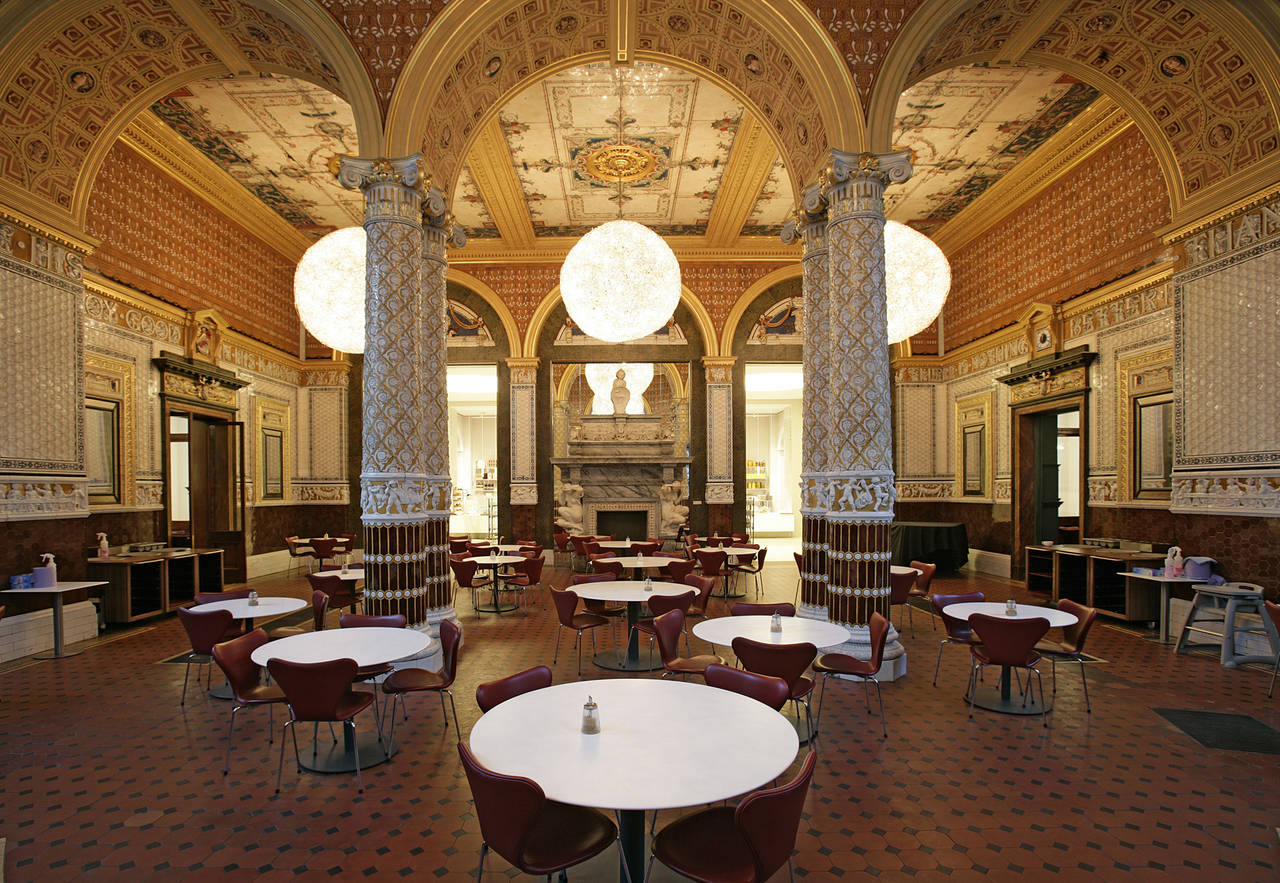 Gamble Room. Photo credit – V&A
The Morris Room (The Green Dining Room)
Designer William Morris led the Art Nouveaux movement of the last decades of the 1800s but was still a relatively unknown 31-year-old, when appointed to design this room. The swirling decorative elements of his art style are noticeable, as are distinctive Gothic Revivalist features, and you can add a touch of the Pre-Raphaelites in the mix, as painter Edward Burne-Jones was one of his pals and helped with the design. Burne-Jones’ work can be seen in the zodiac sign symbolism and stain glass figures.
‘Have nothing in your house that you do not know to be useful, or believe to be beautiful.‘ –William Morris
With such a painterly approach, it soon became a popular hangout for the art crowd, with James Whistler and Edward Poynter regular visitors. However, it’s own designer, William Morris, preferred to dine in the Poynter Room.
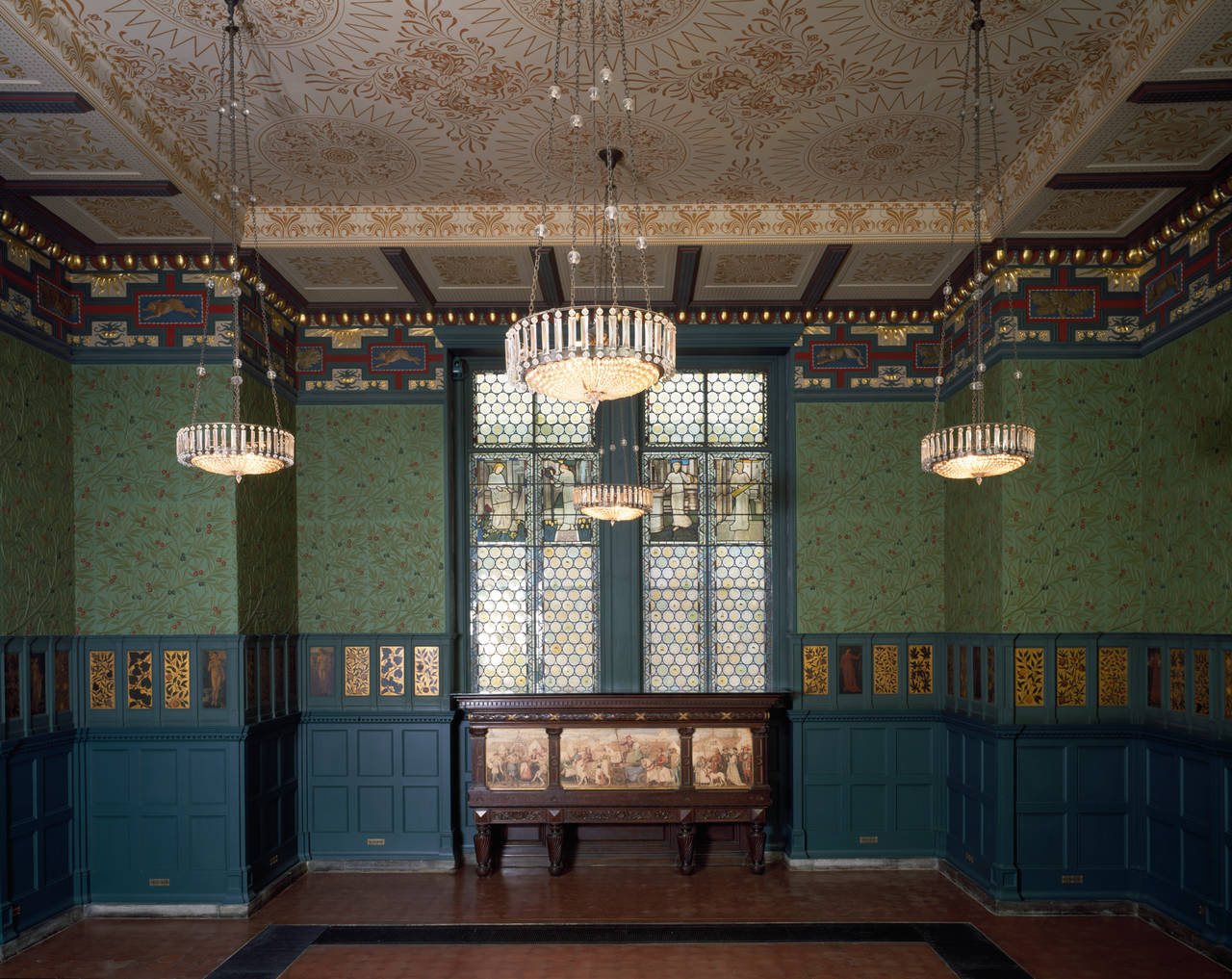 Morris Room. Photo credit – V&A
The Poynter Room (Grill Room)
The artists and designers of this period were a close knit bunch, with Whistler and Poynter both students under classical painter Charles Geyre. When not painting masterpieces, Whistler would visit the V&A to admire the design work of his painterly pals. Poynter’s sister married Edward Burne-Jones so the cross-flowing fortunes of those in high circles never more marked than in the dining rooms of the V&A.
Painter-designer Poynter was well respected in the Victorian art world and his name fitted the vibe of this new highbrow eatery. The Grill Room, as it was then known, was renamed in his honour even as visitor numbers steadily increased, drawn by the broiled chops and steaks which gave the room its earlier name. Perhaps, that’s why William Morris preferred this room. Or was it the glazed ceramics on the lower walls depicting classical figures. The upper walls bore paintings on the tilework depicting the months and the seasons, painted in a saturated blue-grey palette.
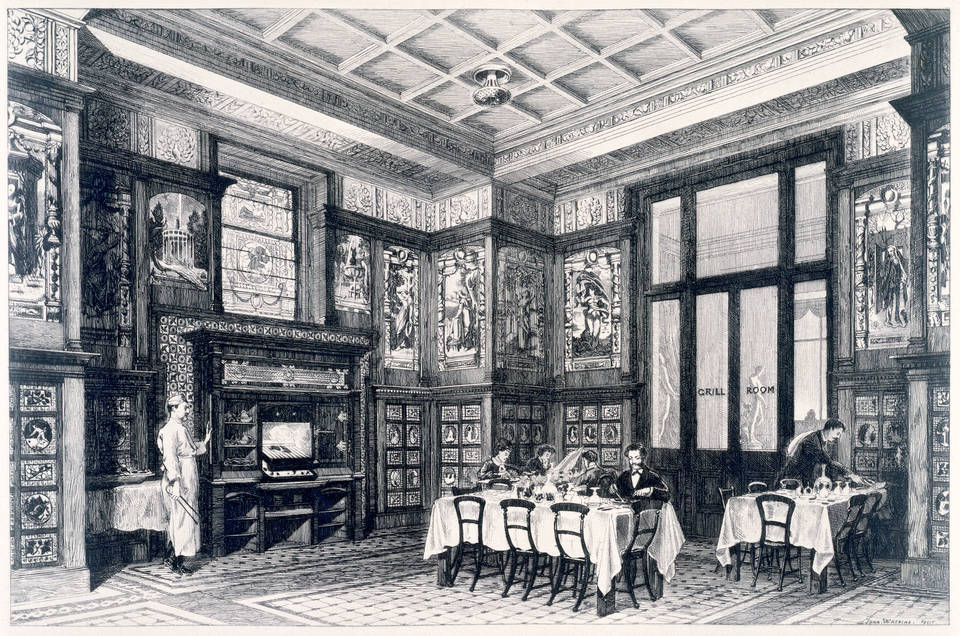
The Poynter Room is unchanged since the Victorian age. Photo credit – V&A
The V&A Leading The World
The world’s largest museum of applied and decorative arts and design
The world’s first museum restaurant
The world’s first museum to use gas lighting
More What’s Hot London? Museums