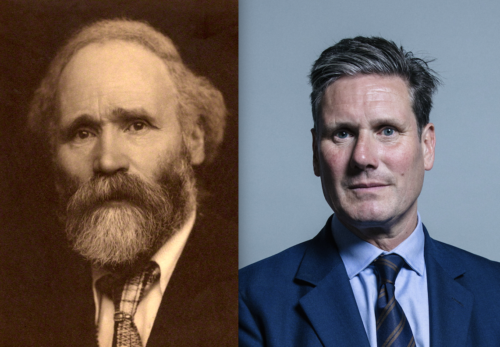
Keir Hardie Created The Labour Party. Will Keir Starmer Destroy It?
Prime Minister Keir Starmer was named after Labour Party founder Keir Hardie. Starmer’s factory worker father and NHS nurse mother, were staunch Labour supporters, old-fashioned socialists and, no doubt, the driving force behind his political aspirations to make a fairer Britain for all classes of working people, and working-class communities in need. Following the recent disastrous Labour local election results, is the collapse of the Red Wall of Labour voters a red flag that he is betraying Keir Hardie’s core principles and losing Labour hearts and minds?
Keir Hardie has much-celebrated links with the London borough of Newham, East London, serving a historic term as MP for West Ham South from 1892-95. In the recent local elections, his Labour heartland in Newham failed to hold on to their working majority. Their 59 seats were slashed in half: the 29 seats five short of a majority. A shocking result considering that Newham is traditionally as Labour red as the Red Wall heartland in northern England and Wales, which fell just as emphatically. The wider East London area was also broadly Labour until these elections, with the party suffering its lowest-ever seat count in Tower Hamlets and the Green Party triumphing in Waltham Forest and Hackney, with Hackney electing its first Green Mayor. This wasn’t just emphatic, it was historic landslide after historic landslide. So, how do we explain the widening ideological gulf between the two Keirs, and is Starmer’s all-embracing centrist approach lacking vision and ideological substance?
Kier Hardie – History Born in 1856, James Keir Hardie was a Scottish trade unionist who founded the Labour Party with a political ideology closer to former Labour leader Jeremy Corbyn’s than current leader Starmer. Keir Hardie’s working-class roots were the driving force behind his desire for a socialist Labour Party that protected workers’ rights and fought for social justice. His political voice was forged from an early life of struggle. Uneducated until the age of 17, he taught himself to read and write. He worked in a bakers from age 8 and as a trapper in a coal mine aged 11, sitting in the dark for up to 12 hours, opening and closing ventilation doors – the only breadwinner in the family even at that young age.
It was in these Scottish coal mines that his public career took a remarkable turn, with his formation of Scotland’s first national union, uniting all mines under one body. Indeed, it was Keir Hardie who roused the workers and organised Lanarkshire’s first ever miners strike, which led to him losing his job and being blacklisted across the region. However, his mission to bring positive change to the lives of the working-class in and beyond Scotland had been ignited.
He founded the Scottish Labour Movement in 1888, and in 1892 moved to East London to stand as the Independent Labour Party’s MP for West Ham. He won the West Ham South seat, becoming Britain’s first working-class and socialist MP and the party’s chairman and leader – a formidable feat. To do so he had to win over a working-class vote firmly entrenched in the incumbent Conservative MP, Major George Banes, a wealthy, upper-class member of the privileged set who was rarely seen in the East End or in Parliament while serving as West Ham’s MP. The Victorian press hailed this political duel: “the major versus the miner.” West Ham’s constituents voted 5,268 in favour of Keir Hardie and 4,036 for Banes.
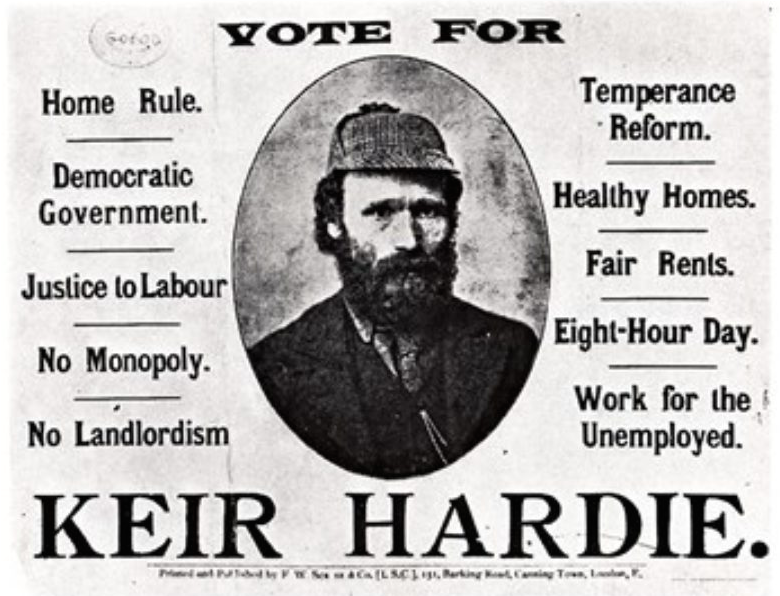
Hardie was still at the helm when the party changed its name to the Labour Representation Committee (1899) and the Labour Party (1906). By that year, he had secured a historic platform. as the first Labour leader in the House of Commons. An unshakeable, outspoken socialist and pacifist he spoke in favour of Indian self-rule and against the Boer War. He stood shoulder to shoulder with Emmeline Pankhurst in East London as the suffragettes’ chief adviser, rallying women voters and the poor, in his constituency and beyond.
This historic connection to Newham lives on today. Keir Hardie’s former West Ham ward covers much of the London borough of Newham. In Canning Town, Newham, the Keir Hardie Estate, Keir Hardie Primary School, Keir Hardie Recreation Ground and Keir Hardie Methodist Church are all named in his memory. And the borough reverberates with the momentous occasion in 1892 when he waved from the balcony of West Ham Town Hall (now Stratford Town Hall) on being elected MP for West Ham South.
Fast-forward a century or so, and the political party created for the working-class has struggled to reconnect with its core electorate. The ideals of Keir Hardie reborn in Jeremy Corbyn were resoundingly rejected in the 2019 General Election, with Labour collapsing to their fewest seats since 1935. The nation now sits in a wobbly centrist position, with the electorate increasingly lured right by the charge of Reform. Can a leftist vision under more charismatic and capable Labour leadership contenders such as Andy Burnham, reshape Keir Hardie’s legacy and the driving principles behind the party’s foundation?

Many Labour stalwarts believe it is no longer just a ‘tale of the two Keirs’ as Starmer has had his time and the landslide voting swing indicates he is either not up to the job, lost the trust of the public, or both. Other Cabinet faithfuls insist he has kept most of his policy pledges – even where these have not been voiced passionately to the electorate. So, perhaps more grey and efficient technocrat than charismatic, messianiic leader with a broad yet inspired vision or fiery oratory in the Churchillian vein.
Wait a minute. If the pro-Starmer argument is ‘yes, he has delivered – you just didn’t catch it!’, this, surely, implies that Labour’s historic loss of 1500 seats – 60% of the seats they were defending in England – is down to the very odd voting behaviour of the ill-informed, easily swayed, politically-fickle masses, not a betrayal of core Labour principles under a maxim unpalatable to the left or giddy centrist policies too thinly-spread and weakly-delivered to catch the hearts and minds of progesssives, centrists, the right, or anyone in between. If the latter, an uncontested Reform surge was inevitable.
Simpler, more direct, and impassioned political messaging is needed, it seems. Indeed, it was Renaissance genius Leonardo da Vinci who once opined that simplicity is the ultimate sophistication, so let’s make this one line round-up of the local elections nice and simple: – ‘People voted for the Greens and Reform because they just couldn’t see any alternative’. It’s that simple. Take note.
More WHL Politics