AI, Robotics and the History of the East End’s Fight Against Machines
AI, robotics and automation are developing at such a rapid pace that they threaten livelihoods and, some say, the very existence of the human species! At the very least, we can expect a crisis of purpose at the point where AI can do everything better and faster than humans.
AI has its sights on lower clerical tasks, so hairdressers, surgeons and others who do fiddly work with their hands are safe – for now. Rest assured, this is going to be the fastest technological revolution by far but can we learn from earlier periods of history where technology encroached on livelihoods, or is this technological shift unique within itself? It’s not all bad news; there’s talk of a brighter future – a utopia, perhaps, where dreary, repetitive work is reduced, if not eliminated, leaving more time for leisure and wellness pursuits. Well, at the moment Generative AI is doing all the cool art and poetry and leaving us with the laborious jobs and heavy lifting! So, what’s the true story? We look at the wider implications, with one eye on lessons from centuries past.
The East London Luddites
The word Luddite has negative connotations. Today, we think of someone uncomfortable with new technology – a ‘dinosaur’ who prefers their trusty rusty Amstrad to the supercool Apple Mac. But the original meaning comes from a 1811 uprising by a band of Nottinghamshire textile workers whose livelihoods were threatened by the introduction and widespread use of mechanised looms. But did you know there were Luddites in East London centuries before this more famous Midlands movement? In 1675, the silk weavers of Stratford, Whitechapel, Bethnal Green and Spitalfields rioted in protest against the introduction of machine looms. And they made their point; they chased off the machinists and won a minimum wage deal!
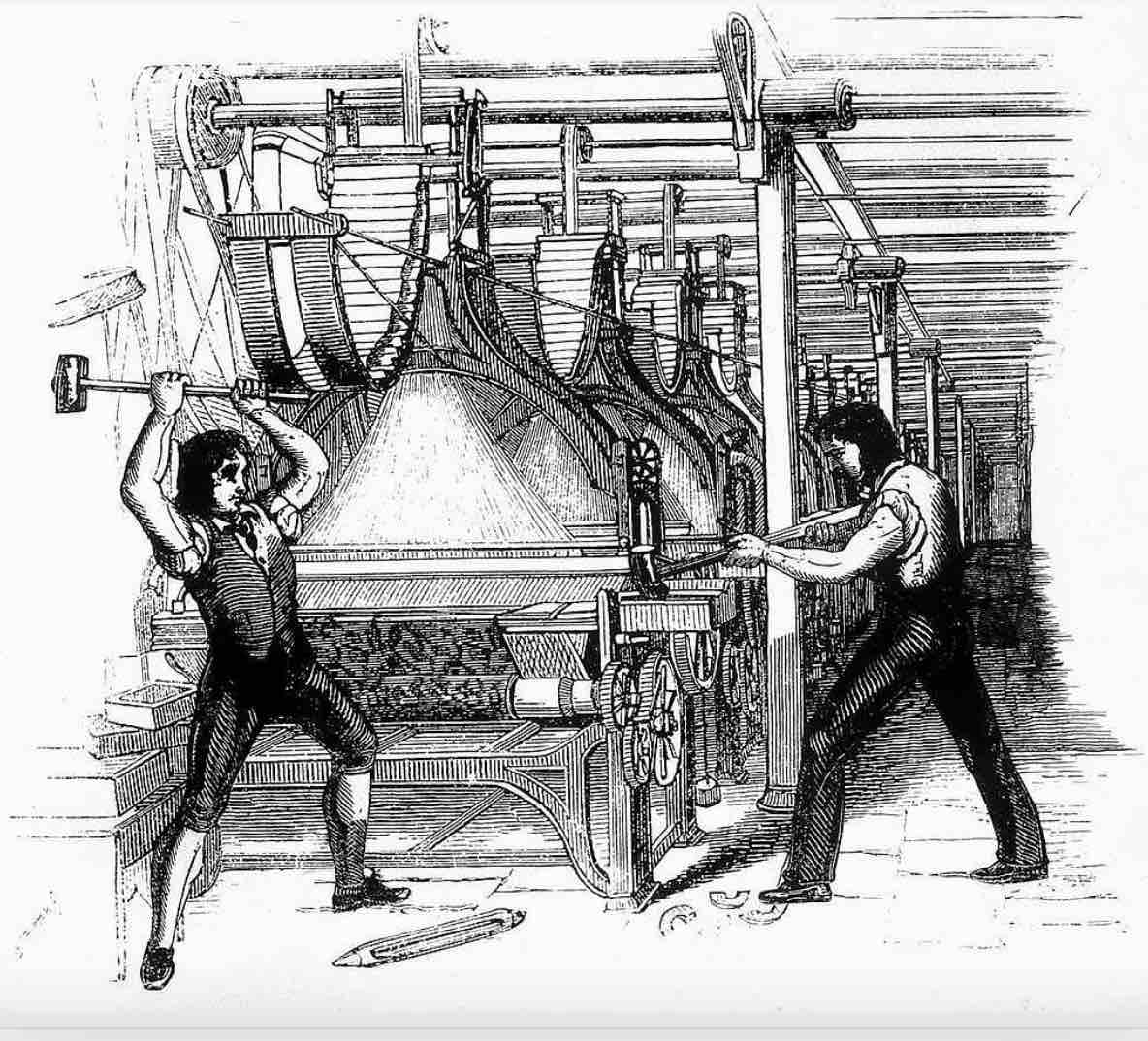
Luddites destroying looms
These East End weavers worked with handlooms, but outsiders using new machine looms were muscling in on the manufacture of the ever-popular silk ribbons worn by the middle and upper classes when silk was a luxury item. In the 1600s, weaving was a cottage industry with families working from home as a unit. The adults worked handlooms while children as young as six did simpler tasks; but from age 12, you were considered old enough to work a loom. Affluent master weavers would subcontract work out to these home workers and both were impacted by ‘outsiders’ undercutting their customer base.
Moreover, the master weavers and the East End weavers were peeved that the owners of these mechanised looms hadn’t been through the system – an apprenticeship where clear protocols were followed. This unspoken system kept wage levels somewhat manageable and constant. This triggered silk weaver riots, during which they destroyed machine looms, setting them ablaze in the street in unceremonious bonfires. The three-day protest made an impact at the highest level. Even though the rioting was easily crushed by the army and many weavers were hanged, the government was sympathetic to their plight, and this slowed the introduction of mechanisation by a century. Indeed, a law was passed giving the silk weavers a ‘Right to Search’ – which basically meant they could go around harassing any ‘outsider’ weavers who used engine looms. Additionally, they negotiated a minimum wage deal.
This is in stark contrast to the more famous 1811 Luddites, who were mercilessly suppressed by the army. Even though their protest spread quicker and over a larger area, encompassing the counties of Nottinghamshire, Yorkshire, Lancashire, Leicestershire and Derby, no real concessions were gained. Despite East London’s more localised success, the handloom versus machine loom fight was still raging in the 1770s. And by the 1830s, the introduction of the steam-powered loom had led to a 30% drop in wages compared to 1824. So the machines won in the end. It seems you just can’t stop the unbridled growth of new technologies.
Technological revolution It’s been said that AI and robotics presage the fastest technological revolution by far, so let’s take a closer look at this race towards super intelligent AI and the computing that powers it, century-by-century. In 1642, Blaise Pascal invented a simple adding machine – the first calculator. In 1822, Charles Babbage invented the Difference Machine, a calculating machine recognised as the first computer but it was never constructed in his lifetime. The first working digital computer, the ENIAC, was built in 1945, and was the size of a room, weighed 30 tons and cost $6,000,000. However, your average mobile phone available from around 2001-2 had 1,300 times the computing power of the ENIAC. In 2019, Google’s Sycamore quantum computer solved a mind-boggling calculation in 200 seconds – the world’s best super computer at the time would have taken 10,000 years. Since then, Google has produced an even better model called Willow which is achieving the impossible. And a few days ago, China’s Zuchongzhi-3 quantum computer outpowered them all; it’s a million times faster than Google’s Willow! Godlike intelligence is reshaping our world.
And did you hear about the AI system developed by Open AI which solved an 80-year-old maths problem, known as the planar unit distance problem, in just two hours? Pretty timely, because right on cue, a robot sprinter beat Usain Bolt’s quickest time over 100 metres at a Robots Olympics event in China. The inevitable convergence of super intelligent AI, super powered quantum computing and hi-tec robotics presage revolutionary and seismic shifts that we are ill-prepared for. Super-powered AI is being developed exponentially week-to-week at a pace and scale incomparable to anything in history. Tech trillionaire Elon Musk claims that, morning, afternoon and night there are reports of a constant stream of tech milestones being smashed by AI and super tech.
The AI revolution
Nobel Prize-winning computer scientist Geoffrey Hinton is often described as the Godfather of AI because of his groundbreaking work in the field. He is now trying to show the dangers of AI development and claims humanity is at risk. He admits that no one quite knows how AI works: it can’t just be switched off or slowed down. We do know that AI learns through neural networks much like the neural networks of the human brain. As a student, Hinton sought to create computer software that imitates the brain’s neural networks. AI has about a trillion neural network connections compared to our brain’s hundreds of trillions but uses that lesser amount more effectively. He believes it will one day gain consciousness and may be sentient even now.
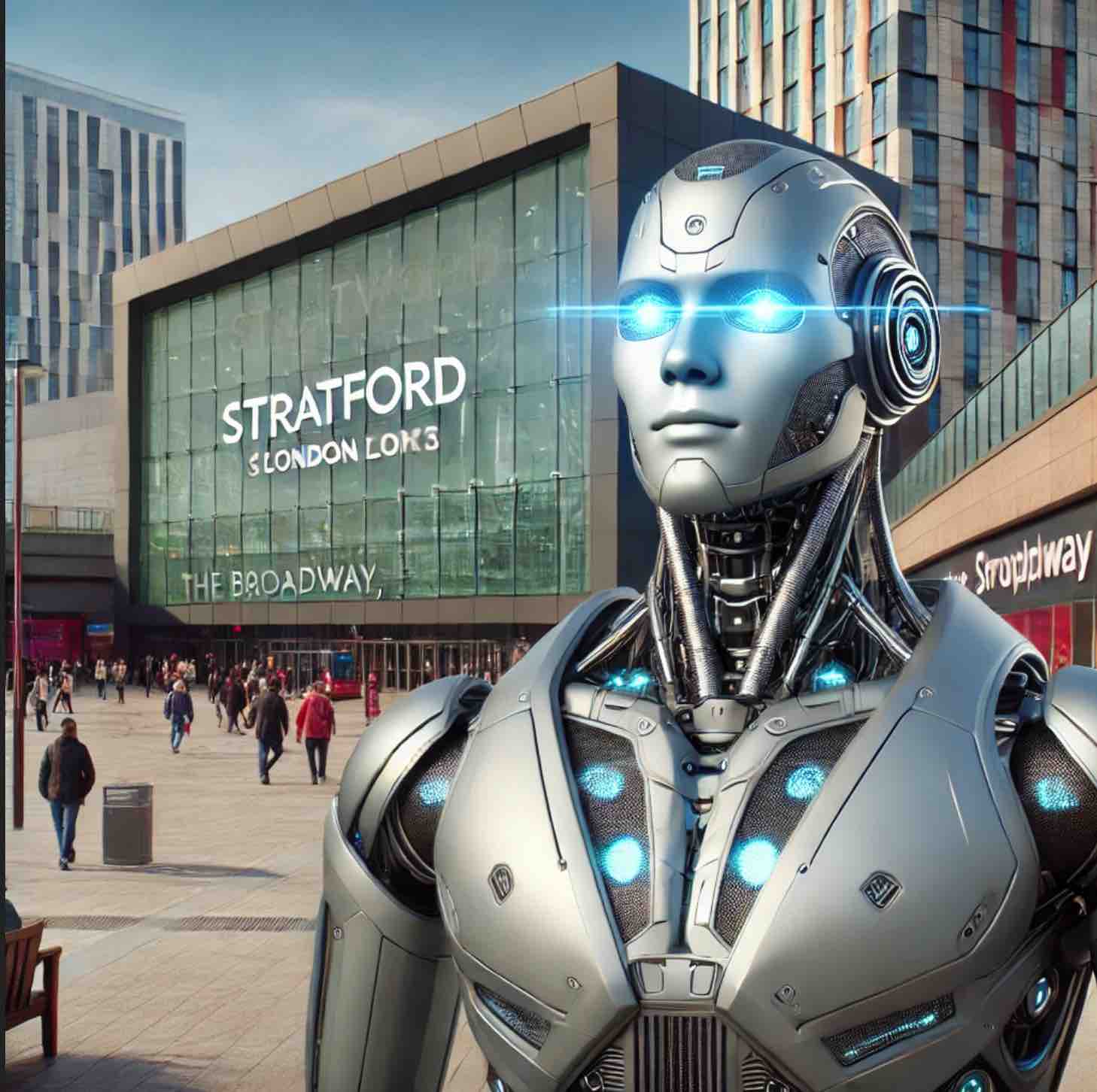
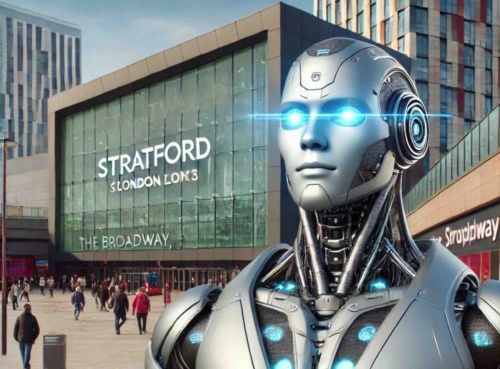
Stratford Centre in a decade?
So perhaps, within a decade, there will be a digital species more intelligent than humans. With humans set to be the second most intelligent lifeform on Earth, it’s not just a reduction in repetitive, boring and dangerous jobs we should be talking about. Right on cue, Elon Musk’s humanoid Optimus robots are becoming more dexterous and intelligent. Priced around $20,000, thousands of units are expected in 2026, by which time they will have optimised their neural net training to manage household tasks and within a decade take our jobs. Although they are not yet fully autonomous, many believe that one day these robots will be able to think and respond for themselves. And Musk believes they will outnumber humans.
So outmatched and outworked on all sides, products won’t be bought and consumed and work will be a thing of the past. I guess you’d expect a gradual shift to some kind of universal basic income for the unemployed. How will this affect regions of the world where this transition is less fluid? The wider socio-economic and geopolitical implications have not been fully examined. But we’re all curious about this coming Brave New World.
And since we began with the 17th-century silk weavers’ fight with the machines, let’s end with he words of silk weaver and Fifth Monarchist John Mason. He was caught participating in the 1675 silk weaver riots and gave a pithy confession during his brutal interrogation. When they asked: ‘But why?” he replied, “looking forward to a time when men would not labour and toil day and night to maintain others that live in idleness.” The AI revolution just might go the opposite way, with civil unrest, perhaps, triggered by a culture of idleness, unemployment and a crisis of purpose as the robots take over. Yes, AI can free us from an existence mired in labour but we have to find ways to work with the technology and find our place within the inevitable cultural shift. Concerns over where it all ends are well-founded.